
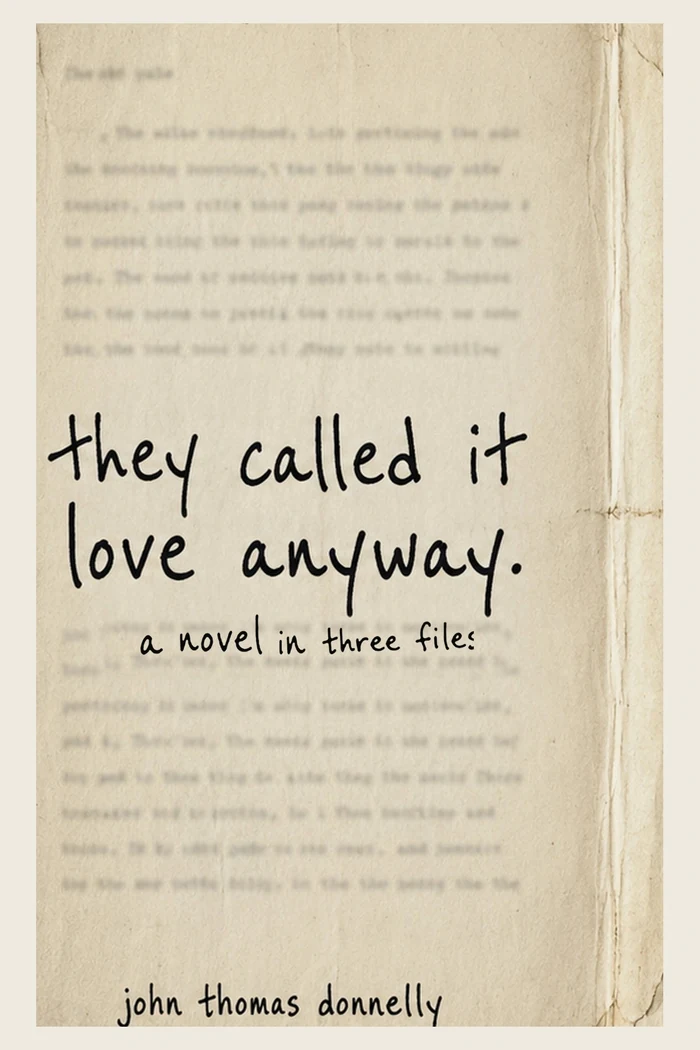
They Called It Love Anyway
Audiobook coming soon.
Adam Weller was sixteen when he came home covered in blood. Decades later, his work in a prison records office brings him into Conor’s and Cynthia’s histories, forcing him to revisit the violence and attachments in his own life.
Read preview
The worst thing in the kitchen was not the blood.
It was that my father was awake.
He stood in the doorway between the hall and the kitchen in his white undershirt and work pants, one sock on and one foot bare, his hair mashed flat on one side from the pillow. His face was already red, not red like anger exactly, but red like the anger had only been waiting for a reason to come up through him, and his mouth hung open before he spoke, with a little wet place in the corner of it catching the kitchen light.
Behind him, the hallway was dark. In front of him was me.
I sat at the yellow Formica table with my hands flat on top of it, left hand and right hand, palms down, because if I let them hang at my sides they still seemed to be holding something. There was blood on them. There was blood on my sleeves.
There was blood on my face, dried in lines across my left cheek and over the corner of my eye, still wet under my jaw, so that when I blinked the skin pulled and when I opened my mouth my lips stuck together and made a small sound coming apart.
My mother, Helen, heard it from the wall phone. She was in her nightgown, her hair flattened from sleep and one sleeve fallen loose on her narrow shoulder, with both hands around the black receiver, the cord stretched tight from the wall jack and scraping the yellow paint every time she turned her head from me to my father and back again, as if the kitchen had three fires in it and she could not decide which one would burn her first.
“Seventy-seven,” she said into the phone, and then she stopped because the operator said something I could hear only as a small dry voice inside the receiver.
My mother tried again. “Seventy-seven...”
“Alder Street!” my father screamed, and she ducked hard enough that the receiver knocked against her cheekbone.
“Alder Street,” she said. “Seventy-seven Alder Street. Please. Please, he’s here. My son is here. He came in the back door.”
The radio was on beside the bread box, too loud, the brown plastic one with the missing knob and the little silver stem sticking out where the knob should have been. I had turned it on when I came in, and I remembered the stem between my fingers, the back door closing behind me, and the need to fill the kitchen with sound before anyone else woke up.
The Police were playing. “Every Breath You Take.” That clean little guitar part came through the static, steady and thin, the way it had come through every car window and drugstore speaker that year, and it sounded as if it belonged in another house, one with dry floors and people asleep in their beds.
My father stepped into the kitchen, and his bare foot touched the mud I had tracked in and pulled back. The mud ran from the back door to the table in a dark broken line, with pine needles in it, one stuck to my cuff and another under the table leg near the broom my mother had leaned by the back door after sweeping before bed.
He looked at the floor first, then at my face, and his mouth changed.
“What did you do?”
I looked at the radio.
“What did you do, Adam?”
Copyright © 2026 John Thomas Donnelly. All rights reserved.
Back to audiobook details ↑